Opinion
QUAD – A new alliance to contain China?
24 Mar, 2022
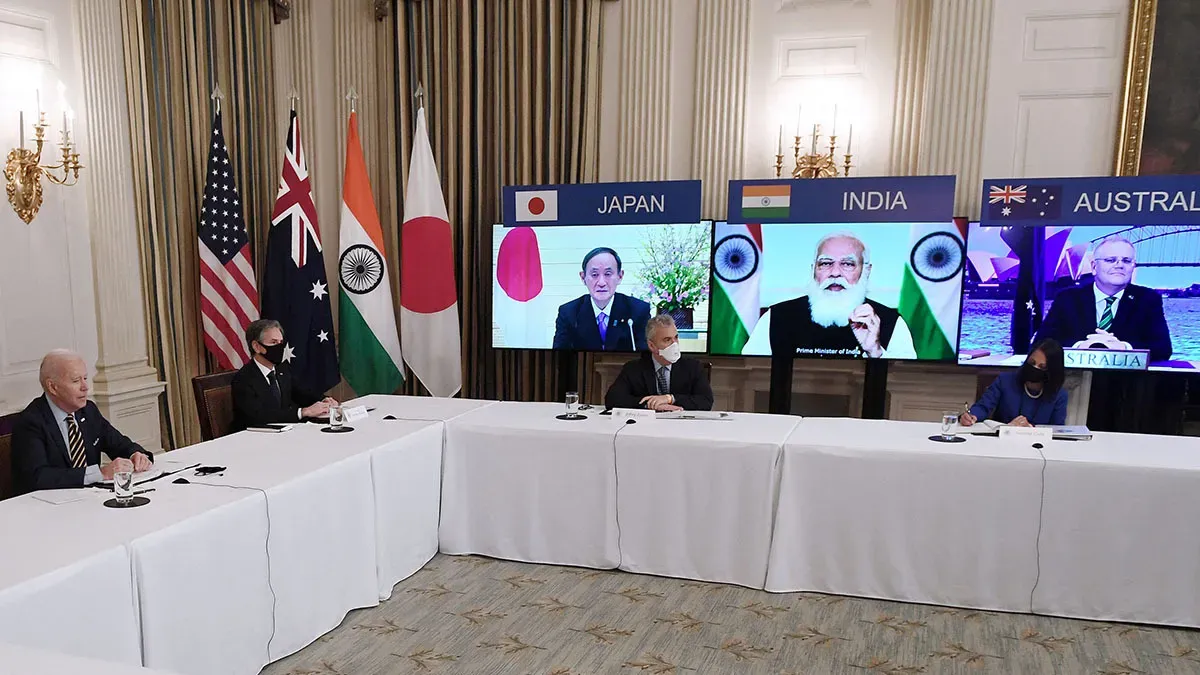
Known as the ‘Quadrilateral Security Dialogue’ (QSD), the Quad is an informal strategic forum comprising four nations, namely — United States of America (USA), India, Australia and Japan. One of the primary objectives of the Quad is to work for a free, open, prosperous and inclusive Indo-Pacific region. The dialogue pertaining to the establishment of this forum was initiated in 2007 by Japanese Prime Minister?Shinzo Abe, with the support of Australian Prime Minister?John Howard, Indian Prime Minister?Manmohan Singh, and U.S. Vice President?Dick Cheney.
The dialogue was paralleled by?joint military exercises?of an unprecedented scale, titled?Exercise Malabar. The diplomatic and military arrangement was widely viewed as a response to increased Chinese economic and military power, and the Chinese government responded to the Quadrilateral dialogue by issuing formal diplomatic protests to its members, calling it “Asian?NATO“.
After a brief period of inaction, as a result of the withdrawal of Australia? during?Kevin Rudd?s tenure as Prime Minister, during the?2017 ASEAN Summits?in?Manila, all four former members led by Abe, Australian Prime Minister?Malcolm Turnbull, Indian Prime Minister?Narendra Modi, and US President?Donald Trump?agreed to revive the quadrilateral alliance in order to counter China militarily and diplomatically in the “Indo-Pacific” region, particularly in?South China Sea. Tensions between Quad members and China have led to fears of what was dubbed by some commentators as “a?new Cold War” in the region.
The Quad is just what it says ? four nations with mutual interests ? gathering to discuss ways they can serve as a bulwark against China?s aspirations to be the sole Asian superpower and spread its repression beyond its borders. The grouping has emerged and receded from prominence over the years but gained new traction following deadly border clashes between India and China in 2020, and a recent surge in Australian diplomatic and commercial confrontations with Beijing.
Indian Response
China, which has territorial disputes with many countries in the strategic Indo-Pacific region, has been vehemently opposing the Quad alliance since its formation. China termed the Quad alliance between the US, India, Australia and Japan as a “tool” to contain China’s rise and to maintain American hegemony. External Affairs Minister S Jaishankar recently dismissed China’s vehement opposition to the Quad, saying the grouping will do “positive things” and contribute to the prosperity and stability of the strategic Indo-Pacific region and criticizing it repeatedly will not make the four-nation grouping less credible.
Jaishankar?s remarks were made after he and other foreign ministers of Quad ?US Secretary of State Antony Blinken, Japan’s Yoshimasa Hayashi and Australia’s Marise Payne vowed to expand cooperation to keep the Indo-Pacific free from “coercion”. The reference to coercion is seen as a veiled message to China’s more assertive and aggressive behaviour in the Indo-Pacific region. “We have serious concerns about continuing cross border terrorism and it is our shared endeavour to deepen counter-terrorism cooperation including in the multilateral fora,” said Jaishankar.
QUAD Grievances
Policy makers in Beijing are driven by aspirations of leadership across their home continent of Asia, feelings of being hemmed in on their eastern flank by US alliances, and their perception that opportunities await across Eurasia and the Indian Ocean. ?Along the way, their first stop is South Asia, comprising eight countries?Afghanistan, Bangladesh, Bhutan, India, Maldives, Nepal, Pakistan, and Sri Lanka? along with the Indian Ocean. China?s ties to the region are long-standing and date back well before the founding of the People?s Republic in 1949. However, around the beginning of this century, Beijing?s relations with South Asia began to expand and deepen rapidly in line with its broader efforts to ?go global.?
General Secretary Xi Jinping?s ascendance to China?s top leader in 2012 and the subsequent expansion of Chinese activities beyond its borders?including through Xi?s signature Belt and Road Initiative (BRI)?have accelerated the building of links to South Asia in new and ambitious ways.
In South Asia, China has encountered a dynamic region marked by as many endemic problems as enticing opportunities. It is a region struggling with violent conflict, nuclear-armed brinksmanship, extensive human development challenges, and potentially crippling exposure to the ravages of climate change. But it is also one whose economic growth prior to the COVID-19 pandemic was robust, that has a demographic dividend, and whose vibrant independent states are grappling with the challenges of democratic governance?including the world?s largest democracy in India.
China?s expanding presence in the region is already reshaping South Asia, which is simultaneously emerging as an area where US-China and regional competition plays out from the Himalayan heights to the depths of the Indian Ocean. Experts began to examine how an array of issues?from military affairs to border disputes, trade and development, and cultural issues?come together to shape and be shaped by Chinese involvement. Their deeper explorations of US interests in South Asia amid China?s growing role; Beijing?s interests in and approach toward the region; China-Pakistan relations; China-India relations; and China?s relations with the smaller South Asian states?Afghanistan, Bangladesh, Bhutan, Maldives, Nepal, and Sri Lanka.
As the United States and other countries such as India, Japan and Australia work to fulfill its vision of a free and open Indo-Pacific region and to respond to a more assertive China, the views of experts can serve as a road map for these countries.
One important finding is China?s growing focus on a blue-water navy and power projection to the ?far seas? has followed its economic interests. The Indian Ocean is currently a ?far sea? for China, but China aims to make it more of an intermediate one. This enhancement of global reach would be akin to the second island chain in East Asia, the end goal being to project influence all the way to Europe. Over time, China?s geopolitical objective may expand to matching or supplanting the United States and India as the most capable maritime force in the Indian Ocean region. That eventuality raises concerns about freedom of navigation in the Indian Ocean given China?s rejection of conventional interpretations of international maritime law and generally assertive behavior in the South and East China Seas. Moreover, People?s Liberation Army forces could develop the ability to block the flow of US and allied forces into East Asia during a conflict.
To some extent, countries such as Nepal, Sri Lanka, and Bangladesh see engagement with China as a hedge against Indian dominance. They will not welcome US overtures viewed as a proxy for Indian interests. India is historically wary of US bilateral cooperation with neighboring states, but transparency and coordination have improved in conjunction with an overall improvement in US-India relations.
Impact of QUAD
The four Quad members have played a major role in purposefully redefining the “Asia-Pacific” as the “Indo-Pacific“, to deepen trans-regional ties between the Indian and Pacific Ocean areas, and to, in their words, deal more effectively with the?rise of China, the Middle East and Africa. The term “Indo-Pacific” gained traction in the political lexicon and strategic thinking of not only the Quad members, but as of recently also of ASEAN, the European Union, the United Kingdom, France, Germany, and the Netherlands, used mainly with regards to China.
Recommended For You