Opinion
Beginning of the End, or a New Beginning?
05 Mar, 2022
By N Sathiya Moorthy
The much-anticipated yet equally-delayed sacking of two senior ministers has the potential to rock President Gotabaya Rajapaksa?s boat ? though not ground it, at least not as it looks now.
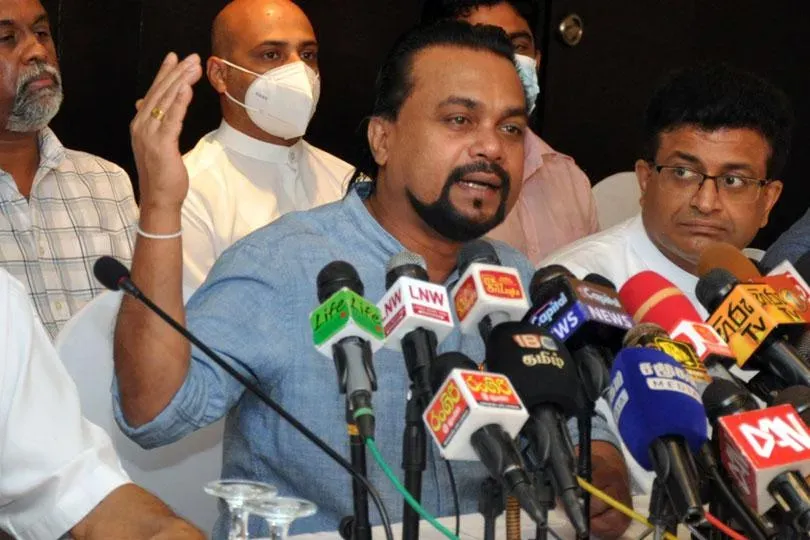
The dismissal of Energy Minister Udaya Gammanpilla and Industries Minister Wimal Weerawansa has much to do with their constant pecking at Finance Minister Basil Rajapaksa?s handling of the nation?s finances at this critical juncture ? but there is also the larger picture of they, along with a third minister, Vasudeva Nanayakara, had attended what essentially was a conclave of ruling SLPP ?rebels? in which some Opposition SJB members too were reportedly present.
The significance of the twin-sacking is even more when considered against the backdrop of their induction. In a welcome departure from past practices of previous Presidents, incumbent Gota had entrusted junior partners in the ruling coalition with important economic portfolios. Wimal Weerawansa thus got the coveted Industries ministry and Gammanpilla, the all-important Energy Ministry.
Gammanpilla in particular stayed on in the limelight in recent months over the energy-crisis caused by extended forex shortage, which will continue even after he had left. He also retained the media limelight over the Trincomalee oil tanks farms deal with neighbouring India.
Weerawansa?s choice should have been even more interesting as it would have been challenging for him to head the Industries Ministry, if only the pandemic had not intervened so early in the career of this government. As irony would have it, as a left-leaning leader, it would have been his job to attract foreign and domestic investors with new sops when such investments alone would have re-defined the nation?s economic future and taken it forward.
If President Gota had any socialist plans on the other hand for Weerawansa to pilot, he did not spell out any of them, unlike in the case of his pet ?organic farming? policy. It is possible, Weerawansa is now quitting without even knowing what his boss, the President, intended to do with him, or expected him to do with the nation?s Industries policy and programmes, old and new, if any.
Unprofessional, unethical
All the same, the three, including minister Nanayakara, did the most unprofessional and unethical of things by accepting allegations of the political Opposition and civil society, this time including Colombo Archbishop, Malcolm Cardinal Ranjith, on the controversial Yugadanavi deal, involving an American multi-national, when petitioners moved the Supreme Court. The court has since dismissed the fundamental petitions on this score without even ?granting leave to proceed?.
But that cannot absolve the three of the impropriety bordering on political immorality of continuing in the Cabinet of President Gota and Prime Minister Mahinda Rajapaksa, and still opposing what was a collective Cabinet decision on the Yugadanavi deal. If their claim that the Cabinet was not at all taken into confidence in the matter, they should have had the guts to quit the government without waiting to be sacked. Even then, rules of confidentiality, both moral and legal, do not permit them to disclose as to what was discussed by the Cabinet ? or, not discussed, as they claim. Now they have set yet another unhealthy precedent like many others have done before them on other issues.
Minister Nanayakara?s reported decision not to quit the government and yet not attend office or discharge the duties assigned to him makes it as much ridiculous as it has become funny. However, there are other reports that say that he has decided to quit and join the other two, in ?saying it all?. In a political move, he too wants to be sacked like his comrade-in-arms, and claim martyrdom. Unfortunately, the nation does not seem to be in any mood for conferring martyrdom on anyone other than itself, caught in the multiple mess as it already is. It does not have time and energy for such antics.
Sinking ship or what
Clearly, the three along with a few other SLPP parliamentarians seem ready to jump the boat, which they seem to have concluded has begun sinking and is beyond repairs. They already have the 14 SLFP parliamentarians under former President Maithripala Sirisena, who however still seem wanting to have the cake and eat it too. At present, the SLFP does not seem to have changed its stand that they would needle the government leadership from within.
If nothing else, the SLFP at least does not seem to have seen any ray of hope on the formation of an alternate government in the present Parliament. Rather, they seem to have concluded that even if the government loses the near two-thirds majority in the House, it would still be able to retain the absolute majority required to run the show. There is also the unsaid, underlying anxiety if the Rajapaksas would divide their allies and the political Opposition, as they have already done with the Muslim parties, to sustain a majority, if not the two-third majority.
The rebels within the SLPP dispensation, or at least most of them, would not have forgotten how Mahinda and Brothers managed a comfortable majority on his election as President in 2005. He did so by splitting the Opposition UNP. He fixed the upper-limit at the required 20 though another 10 was reportedly ready to jump over.
There was a particular logic to the numbers. Even while splitting the UNP to acquire a majority, Mahinda R did not want the rival to lose its status as the official Opposition in Parliament. Technically that position would have gone to his in-house electoral ally, the undivided JVP, which had 39 MPs at the time. He took his time dividing the JVP, after he had consolidated his parliamentary position, and the party too began behaving like an ?opposition from within?.
That was when he encouraged Wimal Weerawansa, then among the most popular of JVP leaders and speakers, to split the party with 10 MPs. Later on, ahead of Elections-2015, the JHU walked out of the government of 10 years, to back the prospective Opposition presidential candidate in Sirisena. That was when Udaya Gammanpilla parted company with the JHU, then led by Champika Ranawaka.
Today, there is no JVP worth even the name that it had in 2005. If Gammanpilla now has his PHU, Champika too left the JHU rudderless by joining the anti-socialist competitor in GoP, UNP first and the breakaway SJB, since.
Less said about the fate of individual leaders like the late Mangala Samaraweera and Sripathi Sooriyarachchi, who designed and ensured the presidential poll victory of Mahinda Rajapaksa. Both fell by the way side as they seemed to have acquired a larger-than-life self-image which needed trimming.
The present generation of SLFP leaders and the rest, especially the older generation, still do not seem to be confident that the Rajapaksas won?t win the numbers game that the three ministers had kick-started months back, but with nothing to show that it would work on the ground. As a rule, MPs want to get re-elected. Many of them do not see that happening if they continue in the Rajapaksa camp. But they want to retain their membership of Parliament even more. That they do not want to risk, or so it seems.
Old wine, in old bottle
It is not only that the allies are apprehensive against the Rajapaksas? old games of numerical one-upmanship. They too seem to have restricted themselves to the pre-poll game of 2014-15. They seem to have concluded that weakening of the Rajapaksas? hold over the government and the nation?s polity had to begin from within, so that the political Opposition could jump on to the bandwagon. The SJB seems to be thinking the other way round. They would not want to give up their lead, but do not want to take the lead just now, either.
This may soon throw up an ever-changing scenario, where there would be one presidential aspirant for every politician ranked against the Rajapaksas. SJB?s Opposition Leader, Sajith Premadasa sought to put an end to the emerging internal debate on the subject weeks ago by declaring that he would be the party?s presidential candidate, whenever. Interestingly, no one else seemed to have endorsed it. But then, the debate also ended without trace.
It is anybody?s guess if many of the so-called SLPP rebels would want to be seen in the UNP-SJB company. Sirisena seems to be biding his time on such hopes, but then, he cannot expect any SJB support for more reasons than one ? chief among them being his treatment of then UNP Prime Minister Ranil Wickremesinghe, the overnight sacking and restoration by the Supreme Court.
Then, there are the likes of former Speaker Karu Jayasuriya, who may still stand a chance ? by some reckoning, if the Opposition wanted a ?common candidate? but from within the fold, within the breed. More names can pop up if and when there are greater signs of instability at the government-level. For now, however, SJB?s Premadasa has reportedly assured Upcountry Tamil leader Mano Ganesan, not to entertain ?Sinhala racist? leaders like Weerawansa and Gammanpilla. For its own reasons, the government can only hope that Sajith P sticks to his promise to Mano Ganesan.
What, when and how
Ait is to this end, too, that the Rajapaksas have sought to seal out by sacking two ministers and the President asking other ?rebels? to quit. In between Prime Minister Mahinda has got together allies belonging to 11 parties who met together and kick-started the ruckus earlier in the week, which alone resulted in the immediate sacking of Weerawansa and Gammanpilla. A past master at patch-up politics than any other living leader in the country, he will need to convince his allies and even parliamentarians that he could carry the family still with him, and not the other way round.
Mahinda has his 40-per cent electoral constituency to retain, and expand it by absorbing the 12-13 per cent SLFP vote-bank from the 2018 local government elections ? which alone added up to make the 53-per cent vote-share of Candidate Gota, to make him President in 2019. Or, that is a simple, but not simplistic way, of looking at the results.
That is saying a lot at this stage in the nation?s political career, tinged in economic mismanagement of successive governments, but whose baby President Gota alone has been left to hold. The question is this: Is this the beginning of the end, or a new beginning? If so, what, when and how ? not necessarily in that order.
Dissolving Parliament?
It also does not preclude the forgotten media speculation from the past weeks, that President Gota may dissolve Parliament to order fresh polls after the half-term deadline expires on 20 March, as provided for by the 20th Amendment to the Constitution, brought forward by his dispensation. As may be recalled, JRJ?s Second Republican Constitution empowered the Executive President to dissolve Parliament any time after the first year, which meant instability in perpetuity.
The Sirisena-Wickremesinghe duo?s 19th Amendment struck a compromise between the two leaders by empowering the President to dissolve Parliament, by only within six months to the end of the five-year term. The Rajapaksas changed it all ? and there you are, with the nation counting the life of the current Parliament in days when it should be counting the dollars in its hands to turn around the economy, when everyone has given up hope, and everyone seems wanting a ?commercial break? of the political kind!
(The writer is Distinguished Fellow and Head-Chennai Initiative, Observer Research Foundation, the multi-disciplinary Indian public-policy think-tank, headquartered in New Delhi. email: sathiyam54@nsathiyamoorthy.com)
Recommended For You


